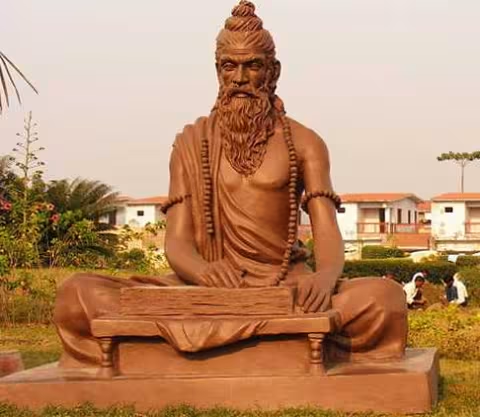
Sushrutha who is said to have lived in Varanasi circa 600 BCE, is widely acknowledged as the Father of Surgery. His treatise on the subject, Sushrutha Samhitha, includes sections dealing with rhinoplasty (nose jobs), congenital lips, ear reconstruction and so on. It was in the 7th century CE that the manuscript was translated into Arabic as Kitab-Shaw Shoon-a-Hindi and Kitab-i-Susrud. It was not until the 19th century that it was translated into Latin and then to other languages.
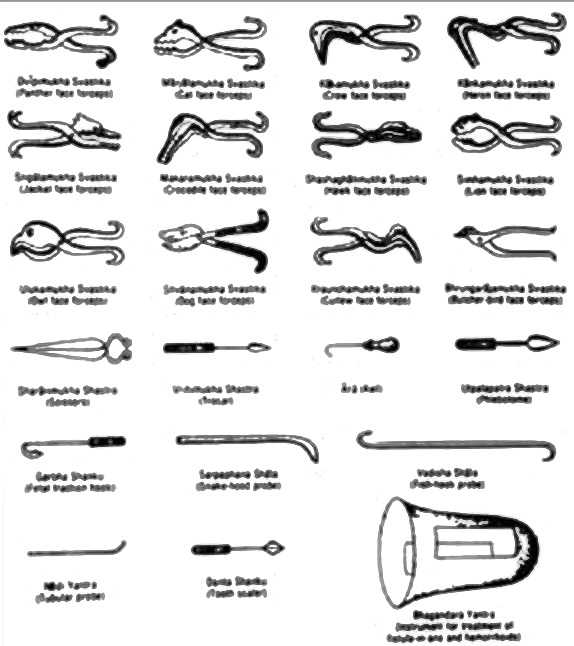
Modern plastic surgery was effectively built upon the foundation of this treatise and a number of techniques and tools outlined within are still in use today. For example, the pedicled forehead flap, a technique for nasal reconstructive surgery detailed in the composition, is still known as the Indian flap.
The oldest surviving version of the Samhitha in written form rests within the Bower manuscript which is estimated to have been compiled during the 4th century CE.